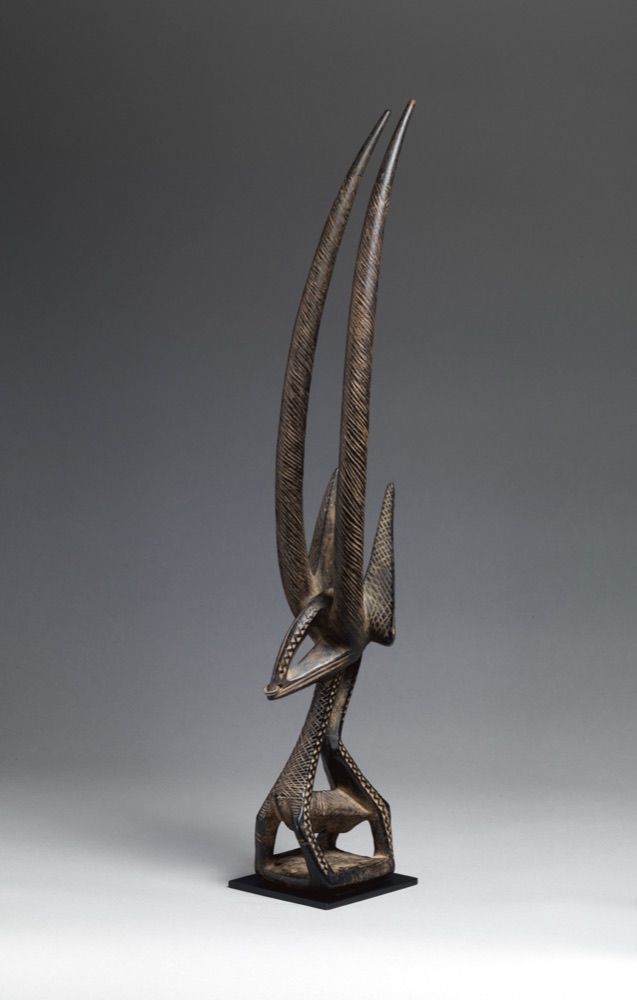
Bambara 35.9%
Bamanan · Bamana · Bamanankan (Mande), a national language
Ségou, Koulikoro, Dioïla, Bougouni and Bamako: the majority in Dioïla (71%), Bougouni (65%), Koulikoro (59%) and Ségou (56%).
The country’s largest group: 35.9% of Malians at the 2022 census. INSTAT links them to the kingdoms of Ségou and Kaarta.
The Kôrêdugaw initiation society, a “rite of wisdom”, is central to Bambara identity, as it is for the Malinke, Senufo and Samogo. The coming forth of the masks and puppets in Markala brings together Bambara, Bozo, Marka and Somono.
Fulani 12.8%
Fulɓe (sing. Pullo) · Peul · Fula · Fulfulde (Atlantic), a national language
Present in every region: 28% of Mopti’s residents, 25% of Nioro’s, 23% of Douentza’s; Bamako, Bougouni and Kayes also have large communities.
12.8% of Malians, and the most widely spread group. In the Inner Niger Delta, the Yaaral and Degal celebrate the herds crossing the river at the end of transhumance, a tradition dating back to Fulani settlement in the region around the 14th century.
In the 19th century, Sékou Amadou founded the Diina of Macina there, a theocratic state. Since 2015, Fulani civilians have been among the main victims of violence in central Mali, including abuses by self-defence groups documented by Human Rights Watch.
Malinke 8.4%
Maninka · Mandinka · Maninkakan (Mande), a national language
Kita (49% of residents), Kayes, Koulikoro and the Mandé, the upper Niger valley south-west of Bamako.
8.4% of Malians. The Mandé is the cradle of the Mali empire: the Keita families who trace their descent to Sundiata mostly live there.
Every seven years in Kangaba, the roof of the Kamablon, the Keitas’ sacred house built in 1653, is redone while Diabaté griots from Kéla recite the history of the Mandé. The Manden Charter, passed down orally in Malinke clans, has been on UNESCO’s intangible heritage list since 2009.
Soninke 8.2%
Sarakole · Marka · Soninke (Mande), a national language
Nioro (44% of residents), Nara (41%) and Kayes (28%), in the Sahelian west; a quarter of Soninke live in Bamako.
8.2% of Malians. INSTAT links the Soninke to the Ghana empire, or Wagadou, the region’s first great state.
Near Nioro, the kingdom of Jaara was ruled from the mid-15th century until El Hadj Umar by the Diawara dynasty, of foreign origin but integrated into Soninke society.
Dogon 6.1%
Dogonon · Kado · Dogon languages (Dogon family), a national language
The Bandiagara escarpment and plateau (93% of the region’s residents), the plain and Douentza (50%).
6.1% of Malians. Villages sit at the foot of the Bandiagara escarpment, a World Heritage site since 1989 for both nature and culture.
The Sigui ceremonies come round every sixty years; masked dances today mostly accompany funerals. The Dogon and the Bozo share a famous joking relationship.
Minianka 5.4%
Mamala · Mamara · Mamara (Senufo), a national language
Koutiala region, where they are 57% of residents, and San (15%).
5.4% of Malians. Their language, Mamara, is a Senufo language: the Minianka and the Senufo are close neighbours in language, counted separately by the census.
Songhai 4.8%
Songhay · Sonrhai · Zarma · Songhay languages (Songhay family), a national language
The Niger bend: Gao (54% of residents) and Timbuktu (40%), and Mopti.
4.8% of Malians. In 1464 Sonni Ali took the throne of Gao and built the Songhai empire; Askia Mohammed reigned from 1493 to 1528 (1492 in other sources).
Songhay is spoken all along the river, from Timbuktu into neighbouring Niger, as several close languages.
Senufo 4%
Senoufo · Syenara · Syenara (Senufo), a national language
Sikasso region, where they are 43% of residents; three in four of Mali’s Senufo live there.
4% of Malians. The Kénédougou kingdom, whose king Tiéba made Sikasso its capital around 1870, grew from a Traoré family of Dioula origin bound to Senufo culture.
The Kôrêdugaw initiation rite, listed by UNESCO, is shared with the Bambara, Malinke and Samogo. Balafon practices of Mali, Burkina Faso and Côte d’Ivoire are also on the intangible heritage list.
Tuareg 3.9%
Kel Tamasheq · Tamasheq (Berber), a national language
Kidal (86% of residents), Ménaka (73%), Timbuktu (43%), Gao (33%).
3.9% of Malians. Kidal region largely covers the Adagh (Adrar des Ifoghas). Tuareg society there distinguished status categories (imushagh, imghad, inadan artisans, iklan) whose boundaries were not fixed.
The imzad, a one-string fiddle made and played by women, accompanies poetry and has a healing role; UNESCO lists it for Algeria, Mali and Niger.
Bwa and Bobo 2.2%
Bwa · Bobo · Bomu · Bomu (Gur), a national language; the Bobo Madaré speak Mande languages
The San and Tominian districts: 29% of the residents of San region.
2.2% of Malians, under one census heading that covers two peoples: the Bwa, settled farmers speaking a Gur language, whom the colonial administration called “Bobo Oulé”, and the Mande-speaking Bobo Madaré.
In San, the Sanké mon, a collective fishing rite commemorating the town’s founding, has been on UNESCO’s Urgent Safeguarding List since 2009.
Bozo 1.9%
Sorko · Bozo languages (Mande), a national language
The river and the Inner Niger Delta: 18% of Mopti’s residents; Ségou.
1.9% of Malians, the river’s fishers. In the delta, traditional fishing rights belong to “masters of the waters”, usually from a Bozo lineage.
Fishing is no longer reserved for Bozo and Somono: in a 2012 survey of 60 fishers, 80% were Bozo. They share a famous joking relationship with the Dogon.
Khassonke 1.2%
Xaasonka · Khassonke (Mande), a national language
The Khasso, the Senegal valley between Kayes and Bafoulabé: 72% of Khassonke live in Kayes region.
1.2% of Malians. The Khassonke describe themselves as of mixed Malinke and Fulani descent. In the 18th century, Khasso’s kings fought the Massassi of Kaarta; Khasso-Dembaya later had Médine as its capital.
Moors 1.1%
Souraka · Bidan · Hassaniya (Arabic), a national language
Taoudénit (31% of residents), Nara (15%), Nioro; a Sahelian presence from the west to the north.
1.1% of Malians. Hassaniya speakers, they live mostly in the Nioro, Nara and Taoudénit regions, along Mauritania.
Samogo 0.7%
Duun · Jowulu · Seeku · Samogo languages (Mande)
Sikasso region, home to three in four Samogo.
0.7% of Malians. The name covers several small peoples with distinct Mande languages. They share the Kôrêdugaw rite with the Bambara, Malinke and Senufo.
Arabs 0.6%
Berabiche · Kunta · Hassaniya (Arabic), a national language
Taoudénit (51% of residents), Gao and Timbuktu; the Azawad, north of Timbuktu.
0.6% of Malians. The Azawad is the “land of the Berabiche”, also home to the Kunta and the Ahel Arawan: above all a camel and sheep herding area.
Dafing 0.5%
Marka-Dafing · Marka (Mande)
San region (4.6% of residents) and Bamako.
0.5% of Malians. Their language, which Glottolog calls Marka, is East Manding, like Bambara. Not to be confused with the Marka of Soninke origin in the Ségou region.
Mossi 0.4%
Moose · Mooré (Gur)
Ségou, Bamako, Mopti and Bandiagara, in small numbers.
0.4% of Malians. Their language, Mooré, is a Gur language; in Mali they live mostly in the centre.
Kakolo 0.4%
Kagoro? · Kagoro (Mande), probably
Kita, Koulikoro, Nioro and Bamako.
0.4% of Malians. The census does not define this group; it is very probably the Kagoro, whose Mande language is close to the Malinke of Kita. We flag this as a hypothesis.
Somono 0.3%
Somono · A dialect of Bambara (Mande)
The river from Ségou to Mopti, and Bamako.
0.3% of Malians. River fishers alongside the Bozo, they speak a dialect of Bambara. They take part in the coming forth of the masks and puppets in Markala.